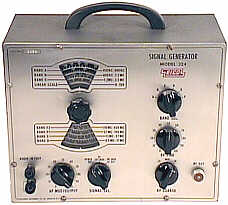
EICO Model 324 Signal Generator
Next to a multimeter, a signal generator is the most useful piece
of test equipment for restoring vintage radios and TVs.
I picked up this EICO 324 generator for $10 at
a church rummage sale. The unit looked little-used,
and it included the original operating and construction manual.
When I got it home, I gave it the usual cleanup
and spent a little time reading the
manual. I powered it up,
and it seemed to work fine. However, I opened it up to clean
the controls and give it a basic
recapping, standard practice for any tube device
of that vintage. Since that time, I have used
it to align many of the radios seen in this website.
EICO test equipment is commmon and you can often find
units like this for $20 or less. The
BAMA website
has free manuals for many test devices as well as boatanchor radios.
You can also purchase manuals from the sources listed on our
Parts page.
Description
The 324 can generate signals from 150 KHz (kilocycles) all the
way up to 435 MHz (megacycles). Most radio alignments use
frequencies well in the lower part of that frequency range.
For example, many AM radios have their IF stages aligned
to 455 or 456 KHz.
To set the frequency, you first select the appropriate band,
with the range containing the desired frequency. Then you turn
the big knob to dial in the exact frequency.
This generator can produce a modulated or unmodulated signal
and it can accept an external modulator. The lower right
knob lets you adjust the strength of the signal output.
Some procedures demand a stronger signal, while others require
a weaker one.
When using the generator for alignment, turn it on for about 30 minutes
before starting the procedure, to make sure it has stabliized
at normal operating temperature. Do the same for the radio
that you're aligning.
The RF output jack accepts a simple shielded cable with alligator
clips on the end. The alignment instructions for a particular radio
will sometimes tell you to connect a small capacitor or resistor
in series with the signal lead, for a particular procedure, so
read those instructions carefully.
What's a Signal Generator Good For?
A signal generator has various uses in radio restoration. If a radio
has become misaligned, the generator can be used to set it right again.
You can also use a signal generator to diagnose radio problems. The
basic idea is to inject a signal with a particular frequency
at the input portion of a circuit and then measure the output
farther downstream, comparing it to the ideal.
To take a simple example, if a radio is completely silent, you can inject an
audio-frequency signal in the audio output circuit to see if the generator's
tone is heard from the speaker. If the signal comes through loud and clear,
you cross the audio output circuit off the list and shift your attention
farther upstream in the radio.
One of my favorite service books, Elements of Radio Servicing by Marcus &
Levy, makes extensive use of the signal generator and explains
how to use it in many different contexts. The book went through several editions
and it's readily available in the used book market and in libraries. You can
also download an electronic copy of the first (1947) edition
from the Antique Radios archives.
Double-Checking the Frequency
The EICO's signal is stable enough for everyday workshop use, but its dial is not very
accurate, compared to modern devices. I use a modern frequency counter or a digital
radio to check the 324's dial settings.
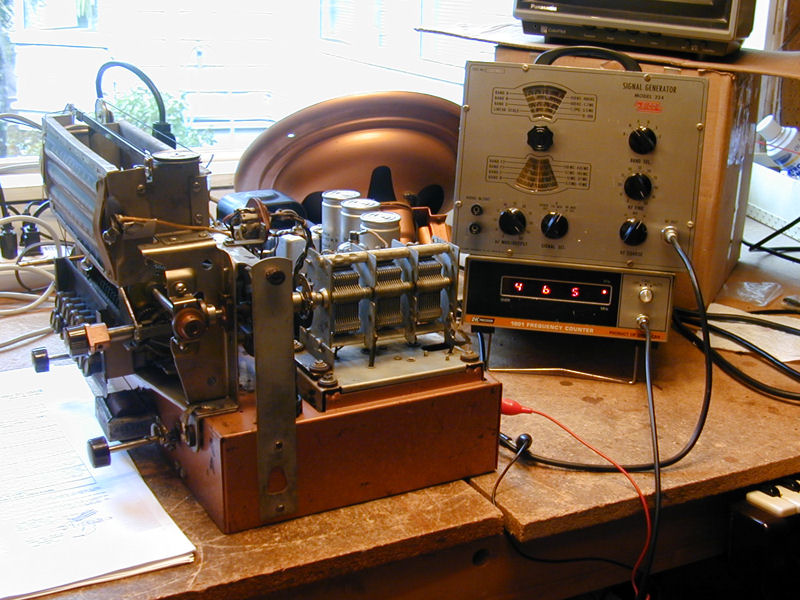
In the following photo, my 324 is sitting on top of my B & K Precision model 1801
frequency counter. The generator's output is set to 465 KHz, the IF
frequency used by the
Stewart Warner 1865 radio on the workbench.

The readout on the frequency counter shows 465 KHz exactly.
You can also double-check the frequency using a modern radio with digital
tuning. I use a Grundig Yacht Boy 400, a multi-band receiver.
Form a couple of turns of the wire into a loop several
inches across—the dimensions aren't critical—and connect the
ends of the loop to the output leads on your signal generator.
Place your digital radio by the loop and tune it to the desired frequency,
then adust the 324's dial setting until the sound heard from the radio is
as loud and clear as possible.
If your radio isn't capable of receiving a certain frequency, try tuning it
to a multiple or fraction of that frequency. For example, my
digital radio can't be tuned to 455 khz, but
it can receive 910 khz, which is exactly twice that frequency. In addition
to the main frequency, the 324 generates harmonics. With
the radio set to the 910 KHz harmonic, I can hear the generated signal just fine.
A Cheap Home AM Transmitter
If you want to have some fun, you can also use this device as a flea-powered AM
transmitter, to broadcast programs to radios in your house. This trick uses the 324's
audio input terminal.
Try connecting the output from
a tape player or other audio source to the audio/ground inputs (lower left in
this photo) of the 324. You will also need to connect some kind of
antenna wire to the RF output terminal at lower right.
Turn on your 324 and then turn on a nearby AM radio and tune it to a quiet
spot on the dial. Now set the bandswitch on the generator to the correct
range and tune it to the same frequency as the
radio's quiet spot. You should hear the signal from your cassette player
broadcast through the radio.
If you're interested in a higher-quality AM transmitter, you can find
complete plans for building one at our Li'l 7 page.
Note: FCC regulations prohibit broadcasting radio signals
beyond a very limited range (essentially, beyond your own dwelling) unless you have a
government license. Please resist
the temptation to connect a giant antenna to your EICO in hopes of broadcasting
a signal over great distances. It won't work well anyway, and the last thing
you want to do is invite a visit from the Men In Black!
Time for an Upgrade!
After using my EICO 324 for about twenty years, I decided it was time for an upgrade.
Although the 324 produces a pretty stable signal, it's very difficult to tune in
a precise frequency in the upper bands, where the frequency is in tens or hundreds
of megahertz. In recent years, I have spent more and more time restoring vintage
TVs, and in some service procedures you need to provide a very accurate signal
in that range.
My new signal generator is a Hewlett-Packard
Model 8660C— quite a leap
upward in quality as well as accuracy.

My old EICO is what you call a service grade
device, suitable for everyday servicing of consumer electronics. The HP 8660C is
a laboratory grade device, designed for more exacting scientific applications in government and
industry. The retail price tag for my 8660C came to a whopping $27,560!
|