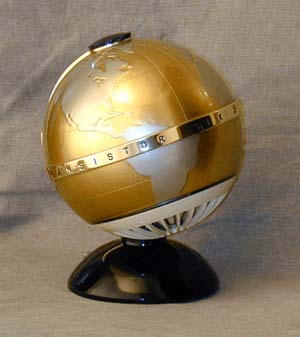
Vista Model NTR-6G Globe Transistor Radio (1960s)


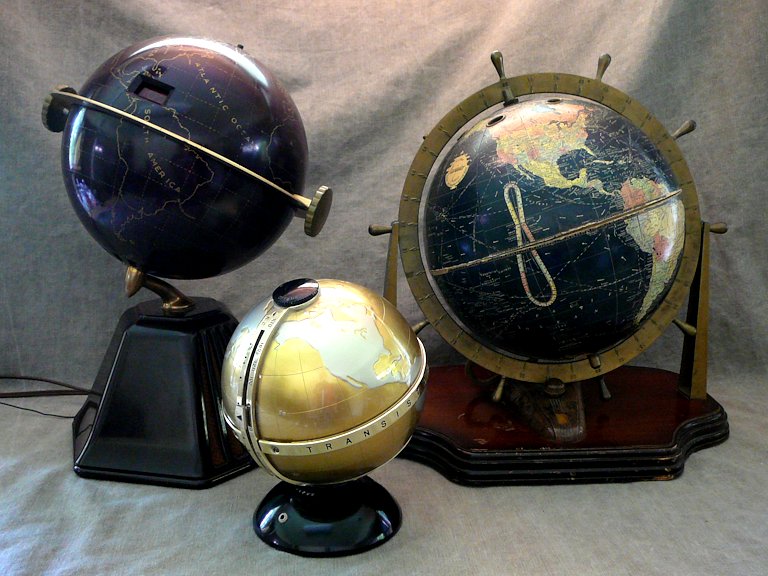
How many radios have you seen in the shape of a globe? I own three of
them: this Vista (aka Fleetwood) model from the 1960s, the famous (and much more valuable) Colonial Globe
from 1933, and the rarely-seen Sonora Globe Navigator from 1940.
If you look in transistor collector guides, you'll find a nearly identical radio
listed under the Fleetwood brand with the same model number (NTR-6G). This set has the name Vista molded
into its equatorial ring, and its owner's pamphlet calls it a Globe Executive Six Transistor Radio,
so I'm calling it a Vista for now. Perhaps, as with many 1960s Japanese imports, the
same radio was sold by different importers under various names.
Inside the globe is a conventional six-transistor receiver powered by six
AA batteries. This radio has a comparatively
large 3-inch speaker. The speaker faces downward, toward the "South Pole." You can see the vents
for the white plastic speaker grille in the first photo.
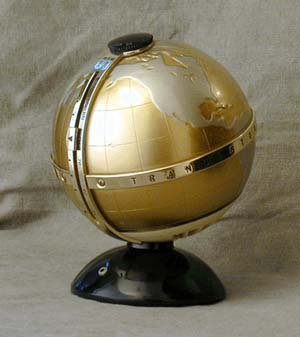
The controls are visible in the second photo.
At the "North Pole" is the black power/volume control. The sliding tuner
control extends from North to South poles. Directly below it, in the
black plastic base, is a little jack for an earphone.
Built decades after the Colonial Globe, this little radio
avoids some of the difficulties of that earlier radio, which was
more than twice as tall and much heavier. The Vista's globe markings
are protected by a thick layer of tough, clear plastic, preventing the
damage that is common to the Colonial's fragile paint. Its globe also
mounts directly to the base, rather than through a gooseneck support,
simplifying construction and making the whole assembly stronger
and cheaper.
Click the icons below to download the Vista globe owner's manual and the Fleetwood NTR-6G service manual:

From a collecting standpoint, it's a little unfair to compare this
inexpensive 1960s set to the Colonial and Sonora sets.
The Colonial Globe is rare and highly desirable, easily worth several hundred dollars,
while the Sonora is even scarcer.
This set is worth far less, perhaps $100 at most.
Regardless of value, it's fun to have three globes in the house!
|