Electronics Illustrated Magazine, January 1961


This January, 1961 issue of Electronics Illustrated magazine includes
a construction article for a tube-powered Theremin. Theremins were invented
in the 1920s by a Russian, Leon Theremin. While not strictly radio-related,
they illustrate an important chapter in the development of electronic music
and they may be appealing to anyone with an interest in tube devices, along with
early instruments such as my
Clavioline and
Solovox.
My other Theremin article has more Theremin history,
so I won't repeat that content here.
The 1961 Tube Theremin
The cover shows a lissome lady playing a Theremin. Unlike all other instruments,
the Theremin is played without any physical contact. You move your hands in the
air near two antennas to control the pitch and volume of the Theremin's single note.
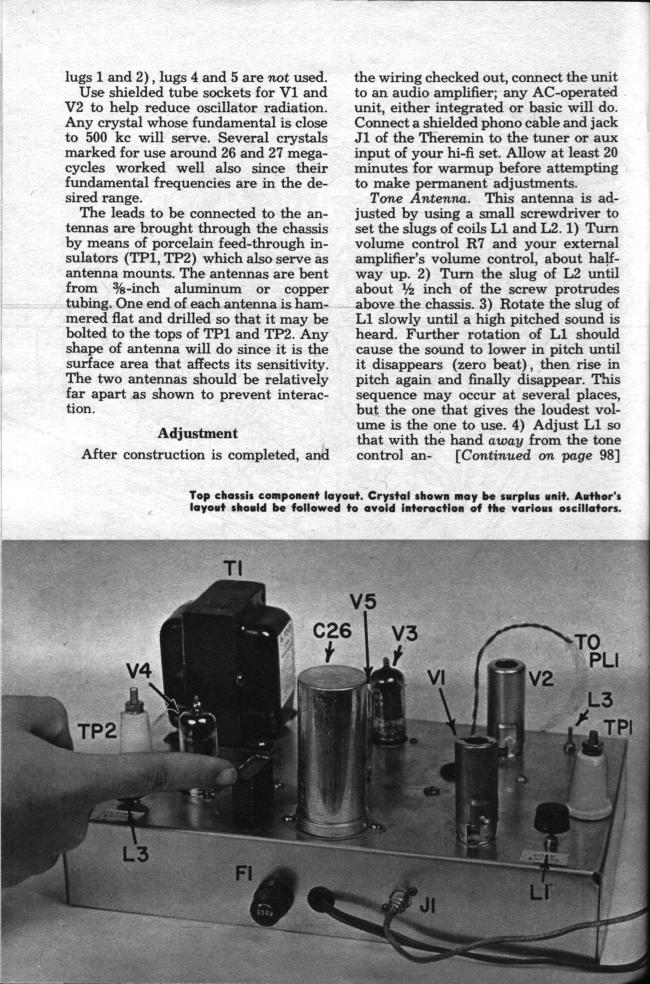
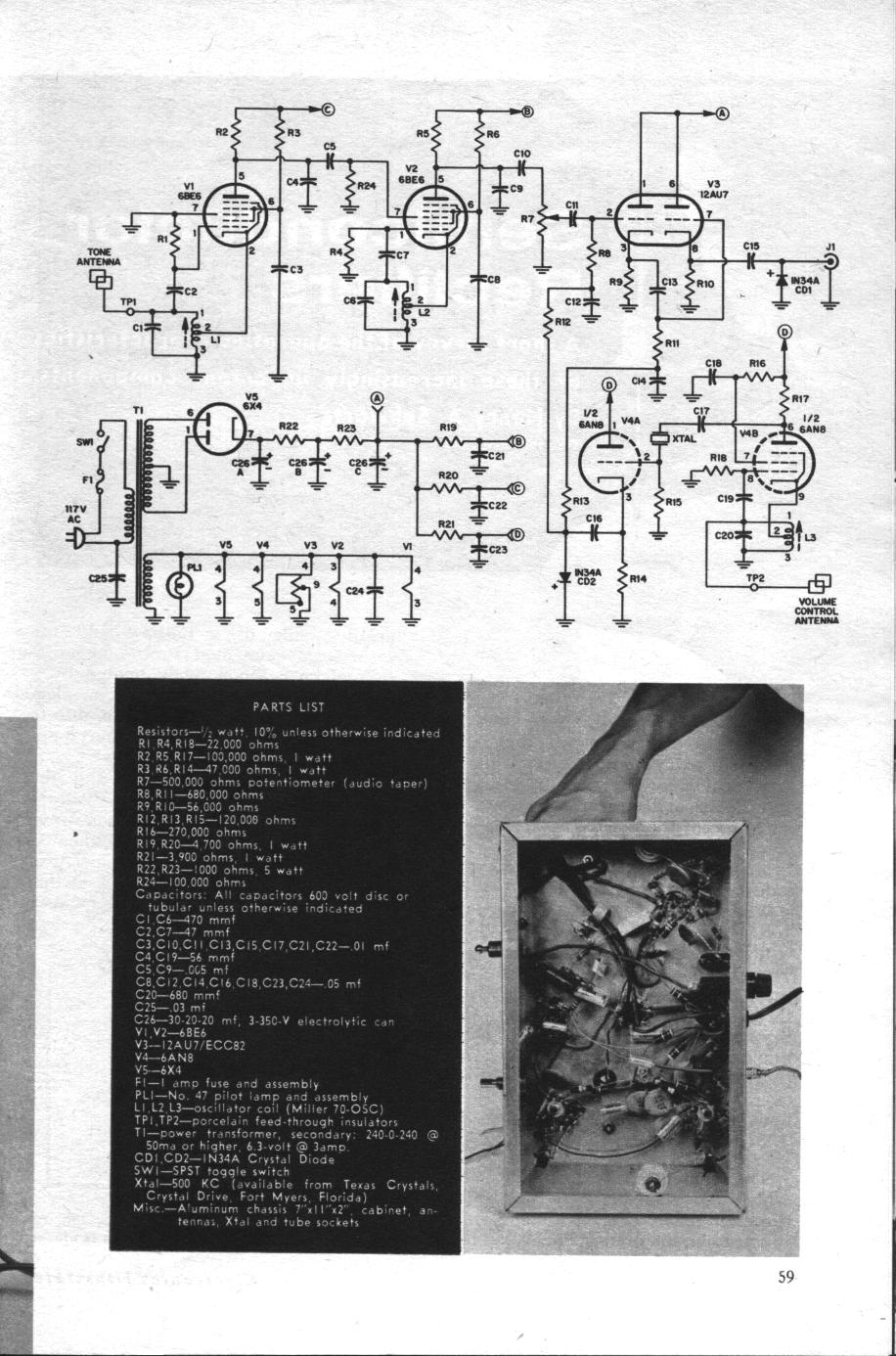
The other pages contain the complete construction article.
This design employs five tubes (6BE6, 6BE6, 12AU7, 6AN8, 6X4) with a
transformer-type power supply. It is somewhat more sophisticated than
the 1955 design shown in my other Theremin article.
The antennas can be any large pieces of metal. This 1961 cover photo shows
a futuristic loop on one side and a metal plate on the other. The
1955 construction article shows large metal letters—a V for
volume and a T for tone. The original 1920s RCA Theremin used
plain metal rods about two feet in length. If you build your own
Theremin, you can let your imagination run riot!
The last page of this article explains the theory of operation.
Simply put, the Theremin produces a tone by combining the output
of two oscillators. The tone's frequency is affected by your body
capacitance as you move your hand near the tone antenna. Similarly,
body capacitance makes the volume louder or softer as you move
your hand near the volume antenna.
While simple in theory, playing a Theremin is difficult in
practice. I have played two original RCA Theremins in different
museums, and found it quite taxing to produce a simple
tune without going off-key. Lacking keys or frets, the instrument
provides no physical feedback to the musician, and thus, it demands
great control.
Nevertheless, they can fun to experiment with, and with
practice, perhaps you can become a Thereminist. I
have heard only one Theremin in live performance, by the
Minneapolis avant-garde poetry/music group known as DaDa
Cha-Cha, some years ago.
Tube Theremin, 2013 Style
In 2013, several years after I first published this article, I was contacted
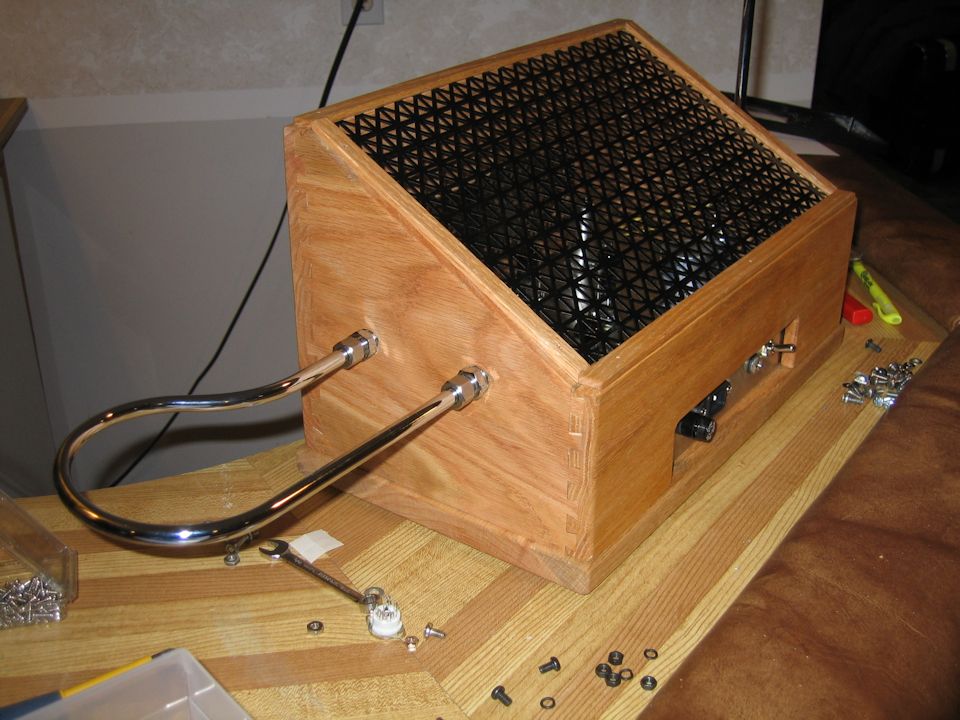
by Craig Hanson, who had built a Theremin by following these plans. The photo
shows Craig's Theremin in a custom wooden cabinet:
In his
article in our
Building section, Craig explains how he successfully completed this project.
Congratulations, Craig! If anyone else builds a Theremin using these plans,
kindly contact me via email.
|